
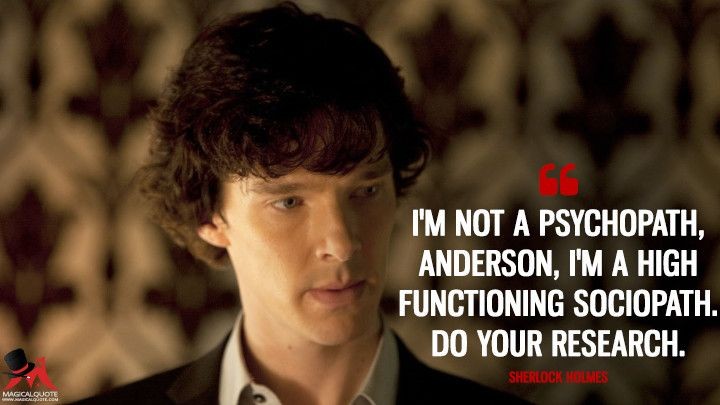
It’s no secret that when the word ‘sociopath’ is mentioned, people automatically think ‘psycho, killer, mad scientist, crazy, psychopath, etc. The closest some of us have come to knowing the truth about sociopathy was ‘Sherlock’. It’s kinda cool when he goes, “I’m a high-functioning sociopath.” This guide has been made simple so as not to be monotonous and to help shed more light on this disorder in a comprehensible manner.
A sociopath is an individual that has a clinically diagnosed personality disorder- Antisocial Personality Disorder(ASPD), which could have a comorbidity with Narcissistic Personality Disorder(NPD). Many of the people who have this disorder, whether they have been diagnosed or not, tend to blend in with members of society. They are even loved by many around them as sociopaths tend to be charming, charismatic, self confident, ambitious, etc.(doesn’t mean anyone you know that has these qualities is a sociopath, please. A person must be diagnosed by a psychologist; a clinical psychologist). ASPD is one disorder that cannot be diagnosed from birth as it is a result of environmental factors such as upbringing, abusive homes, etc.(though it had been argued that biological factors such as genes have a hand in it). People who would eventually develop sociopathy show extremely unruly behaviour in their childhood. These behaviours are known as Conduct Disorder(CD).
The American Psychological Association(APA) created a taxonomical and diagnostic tool that contains different mental issues and their diagnosis. These mental disorders all have criteria, in which a person must meet AT LEAST 5 of these criteria, before they can be diagnosed with ASPD. The manual has been revised time and time to ensure optimum and correct determination of different mental states. The fifth edition of the Diagnostic Statistical Manual(DSM- 5) of the American Psychological Association(APA) is the most current.
DSM-5 CRITERIA FOR SOCIOPATHY INCLUDE:
-Lacks empathy regarding the needs and feelings of other people
-Preoccupied with dreams of unlimited power, success, physical attractiveness, and love
-Has poor or abusive relationships
-Are highly manipulative
-Has a need for excessive admiration and a grandiose sense of self-importance (exaggerates achievements and abilities)
-Repeatedly violating the rights of others through intimidation and dishonesty
-Impulsiveness or failure to plan ahead
-Hostility, significant irritability, agitation, aggression or violence
-Possesses a sense of entitlement and expects favorable treatment or compliance
-Exploits other people to achieve personal goals
-Is envious of other people or thinks other people envy them
-Has arrogant behaviors and attitudes, etc.
As we may have figured out from the criteria above, the line between normal flaws and mental disorder is scarily thin. Mental disorders don’t just happen, they are developed over time. So as you’re doing “This is how I am, take it or leave it” instead of trying to work on your imperfections, be careful you don’t cause yourself more harm than good. They say, ‘Learning is a process that never ends’, we learn till our dying day. Don’t stunt your mental development because you think “love me as I am” is trendy. Self development is crucial in life. BUT, do not let anyone make you feel less of a person because of your flaws. Understand you have flaws and work on them, but don’t let people destructively criticize you or mess with your self worth.
People affected by ASPD are generally believed to lack a sense of moral conscience. They either physically or emotionally abuse their loved ones, crushing their self esteem and making them feel they cannot do without the sociopath(that’s why I asked you to read the Reddit page on the stories of people who have been romantically involved with sociopaths. It’s very enlightening).
However, all hope is not lost for a sociopath as they can undergo treatment. These treatments include:
●Medication
●Cognitive and Behavioral Therapy(CBT) and
●Psychotherapy.
A person with ASPD is usually reluctant to seek treatment or doesn’t believe they need it because they don’t view their behavior as a problem, so it is hard to help many of them. But, if a sociopath knows they need help, goes to therapy and puts in the effort to follow up on their treatment, it can be curbed.
 Words of Dany💫
Brilliant! Capital work Miss Dani! However, subsequently, try and use less labels. How about you exchange “sociopaths” with “a person or person’s with sociopathology/ASPD”. It differentiates the person from the ailment/disorder as one’s disorder doesn’t actually define then. Consult APA & BPS publications for more information on labelling.
Thank you
LikeLike
Okay, thank you
LikeLike